
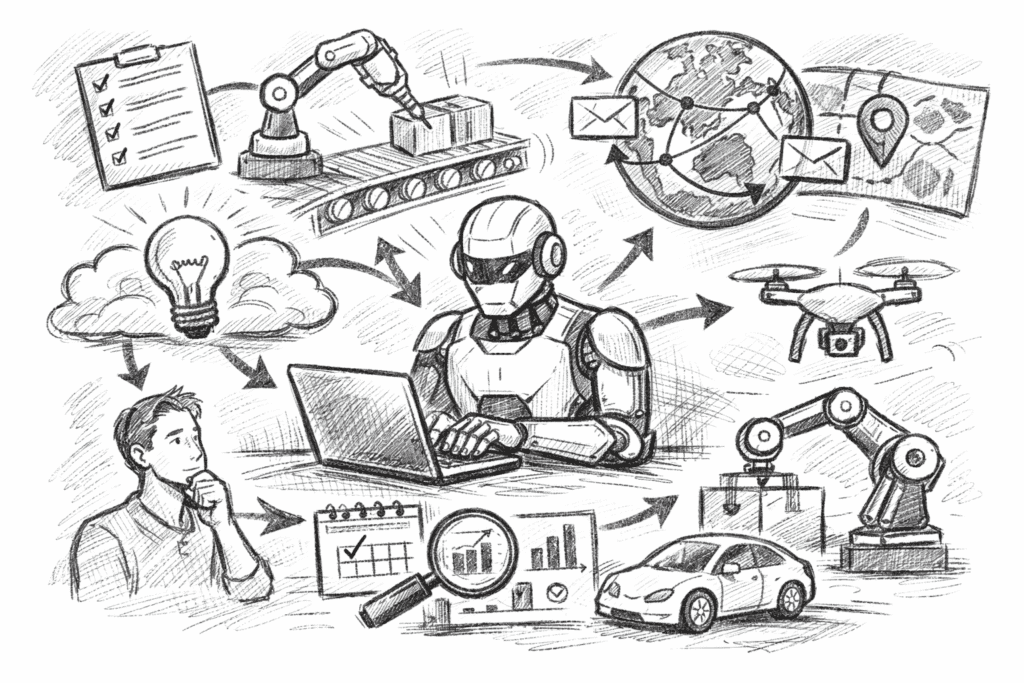
Artificial intelligence has changed fast over the last few years.
However, many beginners still ask the same question: What is Agentic AI?
Agentic AI is different from traditional AI tools.
Instead of waiting for instructions, it acts toward a goal.
In this article, you will get a simple, beginner-friendly explanation of Agentic AI.
More importantly, you will understand why it matters, how it works, and how it connects to modern creator workflows.
What Is Agentic AI? (Beginner Definition)
Agentic AI refers to AI systems that can plan, decide, and act independently to achieve a goal.
Traditional AI tools are reactive.
You ask a question.
They give an answer.
Agentic AI works differently.
You give it a goal, not a command.
For example:
Traditional AI: “Write me a blog outline.”
Agentic AI: “Improve my blog traffic and report what you changed.”
The difference is agency.
To understand how creators already use this model, see
Agentic AI for Creators: The Future of Content Creation
How Agentic AI Is Different from Traditional AI
Many beginners confuse Agentic AI with generative AI.
Although they use similar models, their behavior is very different.
Traditional AI (Reactive)
Responds to prompts
Stops after one output
Has limited memory
Requires constant guidance
Agentic AI (Goal-Oriented)
Works toward objectives
Executes multiple steps
Uses tools and feedback
Adjusts actions automatically
Because of this difference, Agentic AI is better for workflows, not just content generation.
Why Beginners Misunderstand Agentic AI
Most beginners misuse AI tools.
As a result, they think AI is either “magic” or “useless.”
The real problem is how AI is used, not the technology itself.
Common mistakes include:
Treating AI like a shortcut
Copying outputs without strategy
Ignoring context and intent
These issues are explained clearly in
Why Most Creators Fail with AI (And How to Fix It)
Agentic AI solves this problem by shifting the role of the human from operator to director.
How Agentic AI Actually Works (Simple Breakdown)
To understand Agentic AI, think in systems.
1. Goal Definition
The human sets a clear objective:
Grow traffic
Improve conversions
Reduce workload
2. Planning
The AI breaks the goal into steps:
Research
Analyze
Execute
Evaluate
3. Action
The agent uses tools:
Browsers
APIs
Content systems
Analytics
4. Feedback Loop
If something fails, the agent adjusts and retries.
This loop is what makes Agentic AI autonomous, not just smart.
Real Examples of Agentic AI in Practice
Agentic AI is already used in many fields.
Content Creation
An agent can:
Monitor trends
Draft content
Update old posts
Suggest internal links
Freelancing & Productivity
Agents can:
Organize tasks
Automate reports
Improve client workflows
Some practical tools are discussed in
AI Tools for Freelancers: How to Save Time and Increase Income
Business Operations
Companies use agents for:
Customer support
Scheduling
Data analysis
The Human-in-the-Loop Principle
Agentic AI does not replace humans.
Instead, it amplifies decision-making.
Humans still control:
Ethics
Strategy
Final approval
Brand voice
Without human oversight, even smart systems can drift.
Therefore, the best results come from collaboration, not automation alone.
Is Agentic AI Dangerous?
Agentic AI is not dangerous by default.
However, misuse can cause problems.
Key risks include:
Poor goal setting
Bad data sources
Lack of supervision
According to MIT Technology Review, autonomous systems require clear guardrails to remain reliable and safe.
https://www.technologyreview.com
This is why responsible use matters more than raw capability.
How Beginners Can Start Using Agentic AI
You do not need coding skills to begin.
Start simple:
Use task-based agents
Define outcomes, not steps
Review results carefully
Instead of asking:
“Write an article”
Try:
“Create an article outline, check search intent, and suggest internal links.”
This mindset shift is the foundation of Agentic AI.
Agentic AI vs Generative AI (Quick Comparison)
| Feature | Generative AI | Agentic AI |
|---|---|---|
| Input | Prompts | Goals |
| Behavior | Reactive | Proactive |
| Memory | Short-term | Long-term |
| Execution | Single task | Multi-step |
| Role of Human | Operator | Director |
Understanding this table alone helps beginners avoid many mistakes.
Why Agentic AI Matters for the Future
The future is not about producing more content.
It is about executing smarter systems.
Creators, freelancers, and businesses that adopt Agentic AI:
Save time
Reduce burnout
Scale efficiently
Those who ignore it will struggle, not because of talent, but because of leverage.
FAQ
What is Agentic AI in simple terms?
Agentic AI is an artificial intelligence system that can plan, decide, and take actions on its own to achieve a specific goal, instead of waiting for step-by-step instructions.
How is Agentic AI different from normal AI tools?
Traditional AI responds to prompts.
Agentic AI works toward goals, executes multiple steps, and adjusts its actions based on results.
Is Agentic AI the same as generative AI?
No. Generative AI creates text or images when asked.
Agentic AI uses generative models but adds planning, memory, and autonomous execution.
Do beginners need coding skills to use Agentic AI?
No. Many modern Agentic AI tools are no-code or low-code and can be used through simple instructions and goals.
Is Agentic AI safe to use?
Yes, when humans stay in control.
The best approach is “human-in-the-loop,” where AI executes tasks and humans review decisions.
How does Agentic AI help creators and freelancers?
Agentic AI helps automate research, content workflows, planning, and optimization, saving time and improving productivity.
Conclusion: A Simple Way to Think About Agentic AI
If you remember one thing, remember this:
Generative AI helps you create.
Agentic AI helps you operate.
For beginners, this article is the starting point.
From here, deeper systems, tools, and strategies become much easier to understand.
Agentic AI is not hype.
It is simply the next logical step.

Fatima is the founder of SmartCreatorAI25, a blog that helps creators and bloggers use AI tools to grow smarter online. She shares practical guides about AI writing, monetization, and smart productivity.