
AI keyword research for small blogs can feel overwhelming at first. When you open a keyword tool and see huge search volumes, it’s easy to assume that bigger numbers mean better results. However, that logic rarely works for smaller sites.
Instead, small blogs need a smarter system. Because you don’t have thousands of backlinks or brand authority, competing for broad keywords usually leads to disappointment. As a result, AI keyword research for small blogs must focus on precision rather than popularity.
That’s exactly why this guide exists. In the next steps, I’ll show you how to find low-competition keywords, validate them correctly, and build a small keyword cluster that actually grows traffic.
Before we dive in, make sure you understand the bigger structure behind this strategy by reading The AI SEO Content System for Creators. Keyword research works best when it supports a complete content system.
Table of Contents
ToggleWhat Is AI Keyword Research for Small Blogs?
AI keyword research for small blogs is a strategic process of using AI tools to find low-competition, high-intent keywords that smaller websites can realistically rank for. Instead of chasing high-volume terms, it focuses on specific questions, search intent, and topical relevance.
Why AI Keyword Research for Small Blogs Requires a Different Strategy
Large websites usually compete for broad, high-volume keywords. Meanwhile, smaller blogs operate under different constraints. They have fewer backlinks, lower domain authority, and limited trust signals.
Therefore, trying to rank for competitive terms often wastes time and energy. Instead, AI keyword research for small blogs should prioritize:
Low competition
Clear search intent
Specific user questions
In fact, search engines reward helpful content more than keyword stuffing. Even Google Search Central confirms that people-first content performs better over time.
That’s good news. Because if you focus on solving real problems, your blog can grow steadily without chasing impossible keywords.
Step 1 – Start With a Real Problem in AI Keyword Research
Most beginners begin with tools. However, tools only show data — not frustration.
Instead, start with real questions.
For example:
What are beginners asking on Reddit?
What confusion appears in Facebook groups?
What comments repeat under YouTube tutorials?
You can even ask AI:
What specific problems do small bloggers face when doing keyword research?
Real questions lead to real opportunities.
Step 2 – Turn Questions Into Long-Tail Keywords for Small Blogs
Once you identify a question, transform it.
For instance, if someone asks:
“How do I find easy keywords with AI?”
You can turn that into:
AI keyword research for beginners
how to find low competition keywords with AI
easy AI keywords for small blogs
These are long-tail keywords.
Although they may show low search volume, they usually have clearer intent. As a result, they are easier to rank for.
Why Long-Tail Keywords Work Better
Long-tail keywords:
Have less competition
Attract targeted readers
Convert better
Therefore, small blogs should prioritize specificity over popularity.
Step 3 – Validate Competition Before Writing
AI generates ideas. However, you must validate them manually.
Open Google and search your keyword.
Then ask:
Are the top results large brands?
Or are smaller blogs ranking?
Is the content outdated or generic?
If page one is dominated by huge companies, move on. On the other hand, if you see niche blogs ranking, you have an opportunity.
This simple filter saves hours of wasted effort.
Step 4 – Match Search Intent Carefully
Search intent is critical.
Before writing, analyze what users expect.
If you want to see how this validation process turns into actual content production, read AI SEO Workflow for Beginners. It explains how to move from keyword selection to structured execution.
Is the keyword:
A guide?
A comparison?
A tool list?
A quick answer?
For example, if users want a list, do not write a 2,500-word essay. Instead, match the format they expect.
If you want to understand how keyword research connects to execution, review the AI SEO Workflow for Beginners.
Intent alignment increases ranking stability.
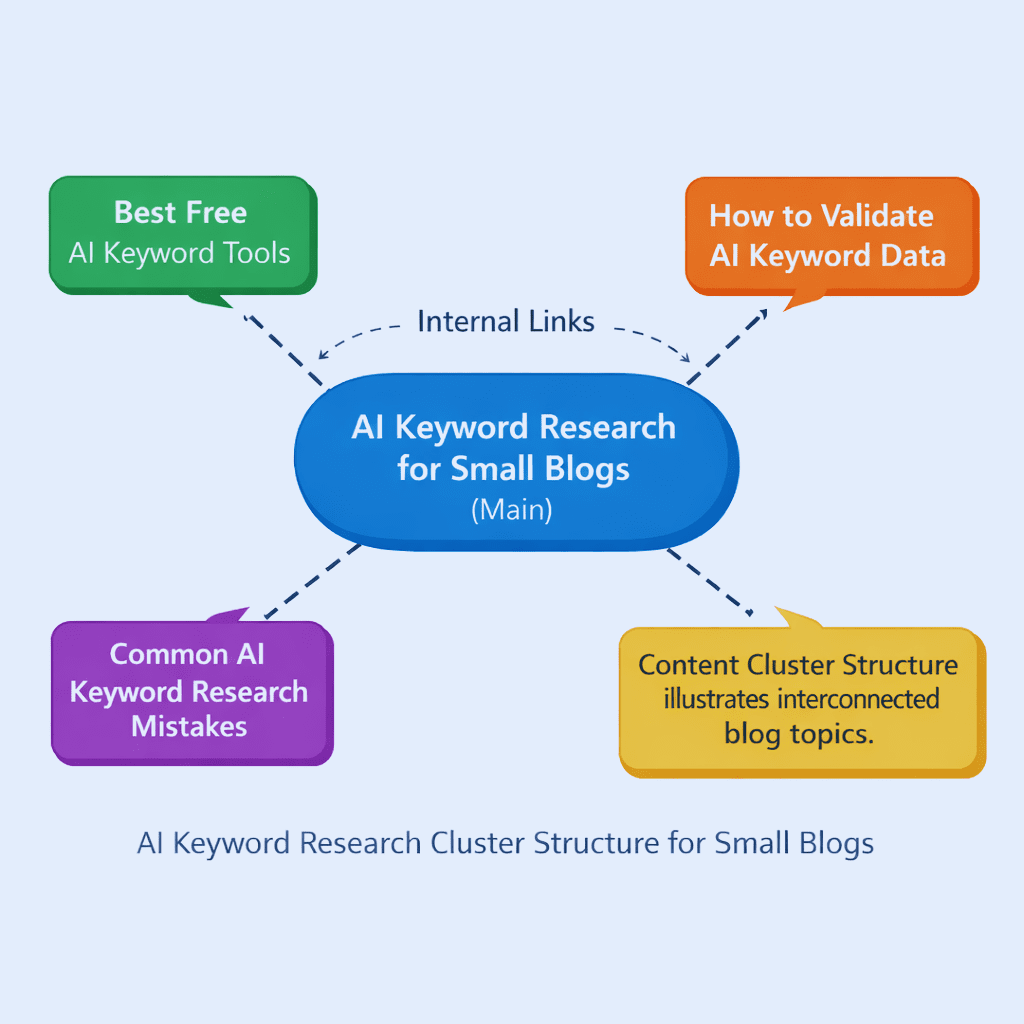
Step 5 – Build an AI Keyword Research Cluster
This is where authority begins.
Do not publish one isolated article. Instead, build 3–5 related posts.
Example cluster:
AI Keyword Research for Small Blogs (main)
Best Free AI Keyword Tools
How to Validate AI Keyword Data
Common AI Keyword Research Mistakes
Now connect them using internal links.
When multiple posts point to the same main article, Google begins to recognize it as important. Consequently, your topical authority grows.
For a full structural approach, revisit the The AI SEO Content System for Creators.
Common Mistakes in AI Keyword Research for Small Blogs
1. Chasing High-Volume Keywords
High volume often means high competition. Therefore, avoid them early on.
2. Trusting AI Without Verification
AI suggests ideas. However, it does not always measure competition accurately.
3. Ignoring Internal Links
Keyword research alone is not enough. Without linking related posts, authority cannot build.
4. Publishing Without Consistency
One article is not a strategy. A connected system is.
AI Keyword Research for Small Blogs – Quick Recap
Here is the simple system:
Find a real question.
Turn it into a long-tail keyword.
Validate competition manually.
Match search intent.
Build a small keyword cluster.
No expensive tools required.
No complicated spreadsheets.
Just clarity and consistency.
Frequently Asked Questions
Can small blogs rank using AI keyword research?
Yes. However, success depends on targeting specific, low-competition keywords instead of broad terms.
Do I need paid SEO tools?
No. You can start with free AI tools and manual SERP analysis. Paid tools become useful later.
How long does it take to see results?
Most small blogs begin seeing traction within 3 to 6 months when using consistent AI keyword research and internal linking. Results depend on competition, content quality, and publishing consistency.
Conclusion – Keep It Simple
AI keyword research for small blogs does not need to be complicated. Instead, it requires focus and discipline.
Stay specific.
Stay consistent.
Stay connected.
Next, we will break down AI Internal Linking Strategy so you can turn your keyword ideas into real authority.
One system at a time.
If you want to understand how all these strategies work together, read The AI SEO Content System for Creators, which explains the full framework behind this approach.

Fatima is the founder of SmartCreatorAI25, a blog that helps creators and bloggers use AI tools to grow smarter online. She shares practical guides about AI writing, monetization, and smart productivity.