
Table of Contents
ToggleAI SEO workflow for beginners can feel confusing at first. You see endless strategies, complex tools, and expert advice everywhere. However, most of it doesn’t apply to small blogs.
When I started blogging, I believed publishing more posts would fix everything. Instead, I ended up with random articles and almost zero traction. I remember checking my analytics every morning and feeling disappointed. Nothing was moving. That’s when I realized I needed a real system, not more content.
If you’ve already read The AI SEO Content System for Creators, you know that structure matters. Now, let’s focus on execution. Here is the exact AI SEO workflow for beginners that keeps things simple and sustainable.
What Is an AI SEO Workflow for Beginners?
An AI SEO workflow for beginners is a structured step-by-step process that uses AI tools to research keywords, create optimized content, and connect articles strategically. Instead of publishing randomly, it focuses on search intent, clarity, and internal linking to build long-term authority.
Step 1: Start With One Clear Problem
Before opening any tool, pause.
Ask yourself one question:
What specific problem am I solving?
Many beginners start with keywords. However, problems come first. Go to Reddit. Read comments. Use AI to summarize common frustrations in your niche.
Because when you solve a real problem, relevance becomes natural. As a result, rankings feel less forced.
Step 2: Validate the Keyword Strategically
Now you can open your keyword tool. Still, don’t look only at volume.
If you’re not sure how to choose realistic keywords in the first place, read AI Keyword Research for Small Blogs: Simple System before moving forward. It will help you avoid targeting impossible terms and save you weeks of frustration.
Instead, check:
Is the competition realistic?
Are smaller blogs ranking?
Does the search intent match my content?
If giant authority sites dominate the page, move on. On the other hand, if you see niche blogs ranking, that’s your signal.
This is where AI SEO workflow for beginners becomes strategic instead of random. In fact, small wins compound over time.
Step 3: Build a Clean Outline Before Writing
Never generate 2,000 words in one prompt.
I tried that once. The result sounded impressive at first, but when I reread it, it felt empty and repetitive.
Instead, build a simple structure:
H2 for main sections
H3 for supporting ideas
One FAQ section
After that, generate content section by section. Consequently, clarity improves. Additionally, your article feels more intentional. Most importantly, it avoids generic AI tone.
Step 4: Add the Human Layer
AI can build structure. However, it cannot replace lived experience.
Therefore, add something personal:
A mistake you made
A lesson you learned
A small insight from your blog
For example, during my first months blogging, I ignored internal links because I didn’t understand their impact. As a result, some posts were barely crawled.
Those details matter. Google increasingly values experience. Meanwhile, readers trust stories more than perfect formatting.
Step 5: Connect Everything With Internal Links
An isolated article is weak. A connected system is powerful.
After publishing, always:
Link UP to your pillar guide
Link ACROSS to one related article
Add one relevant external authority link
For example, Google Search Central clearly emphasizes helpful, people-first content.
The first time I connected three related articles together, I noticed my impressions increasing within weeks. That’s when internal linking stopped being “optional” for me.
When posts are connected, Google understands topical depth. Consequently, authority grows naturally.
Common Mistakes in AI SEO Workflow for Beginners
Avoid these mistakes:
generating the entire article in one AI prompt
ignoring search intent
publishing posts without internal links
writing long, dense paragraphs
Short sentences improve readability and keep the article clear.
How Long Should This Workflow Take?
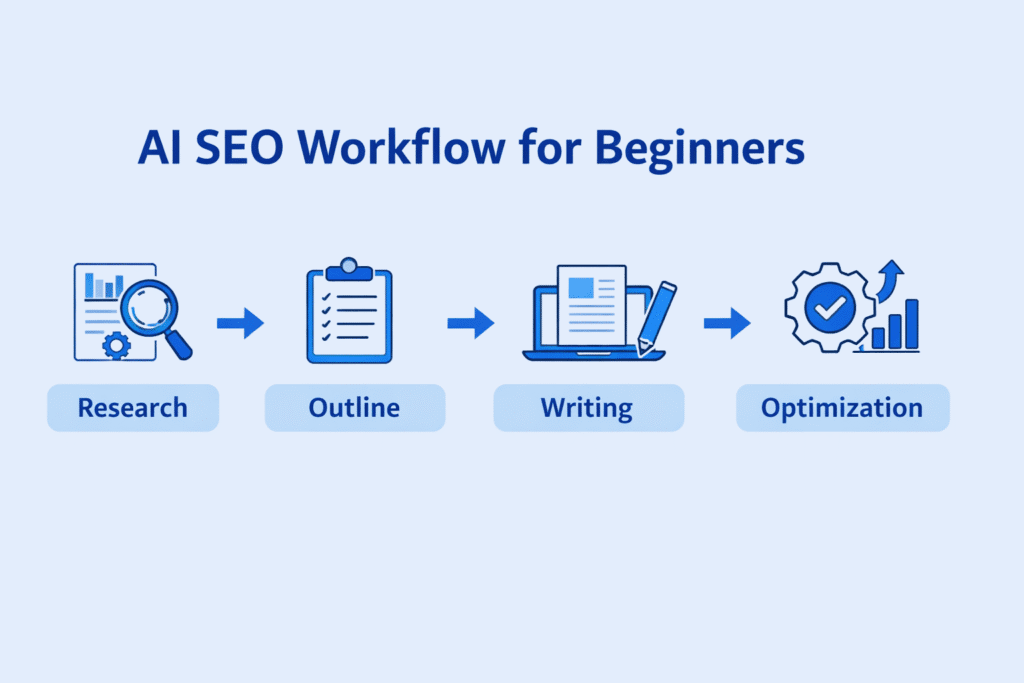
A complete AI SEO workflow for beginners typically takes between 75 and 90 minutes per article. This timeframe includes keyword research, outlining, writing, and final optimization. The focus should be on consistency and clarity rather than speed.
You don’t need three days to produce quality content. However, rushing the process won’t help either.
Here’s a realistic breakdown:
20 minutes – research
15 minutes – outline
30–40 minutes – writing
15 minutes – optimization
Altogether, the process stays within that 75–90 minute range.
That pace is sustainable. Moreover, it allows you to publish consistently without burnout while maintaining quality.
Frequently Asked Questions
What is an AI SEO workflow for beginners?
An AI SEO workflow for beginners is a structured process that combines AI tools with human insight to research keywords, create optimized content, and connect articles strategically. Instead of publishing randomly, it focuses on clarity, intent, and internal linking.
Can beginners rank using AI content?
Yes. However, AI content must be structured, helpful, and enhanced with personal experience. Search engines reward value, not automation.
How long should an AI SEO workflow take?
Most beginners can complete the full workflow in 75 to 90 minutes per article. Research, outlining, writing, and optimization should follow a consistent system.
Is internal linking part of the AI SEO workflow?
Absolutely. Internal linking strengthens topical authority and helps search engines understand your content structure. Without it, even well-written posts may struggle to rank.
Final Thoughts
AI SEO workflow for beginners is not about hacking Google. Instead, it’s about helping people in a structured way.
When you stop chasing traffic and start building clarity, growth becomes predictable. Over time, small improvements create real authority.
If you haven’t yet, read The AI SEO Content System for Creators first. This workflow works best inside a complete structure.
Take it one post at a time.
That’s how authority grows.

Fatima is the founder of SmartCreatorAI25, a blog that helps creators and bloggers use AI tools to grow smarter online. She shares practical guides about AI writing, monetization, and smart productivity.