
Agentic AI content creation is redefining how digital content is planned, executed, and scaled in 2026.
I remember the first time I used a basic AI chatbot to help me write a blog post.
At that moment, it felt like magic.
I typed a simple prompt.
Seconds later, a full draft appeared on my screen.
However, that excitement didn’t last long.
I quickly realized something frustrating. I was spending more time babysitting the AI than actually being creative. Every paragraph needed correction. Every improvement required another instruction. Instead of saving time, I felt stuck managing the tool.
Fast forward to 2026, and that workflow already feels outdated.
Today, we are no longer just using AI tools. We are entering the era of Agentic AI for Creators, where systems think, plan, and act toward clear goals while humans stay firmly in control.
This shift is not about writing faster. It is about building intelligent systems that execute the work—so creators can focus on meaning, strategy, and vision.
Table of Contents
ToggleWhat Agentic AI Content Creation Really Means
Most creators still use AI in a reactive way.
You ask.
The AI responds.
That approach belongs to generative AI.
Agentic AI content creation works differently.
Instead of waiting for instructions, agentic systems operate toward defined objectives. They analyze situations, decide what action to take, and execute multi-step workflows independently.
For a deeper conceptual explanation of this model, we explore it in detail in our guide on What Is Agentic AI.
In simple terms, an agentic system behaves less like a calculator and more like a teammate. It does not just generate output. It takes responsibility for progress.
From Reactive Tools to Proactive Systems
For years, creators were told that success meant producing more content.
Post more.
Publish faster.
Be everywhere.
Unfortunately, that mindset led to burnout.
Agentic AI content creation introduces a different logic. Instead of asking, “What should I create next?”, the system asks, “Where is the biggest opportunity right now?”
This shift becomes possible because agentic systems continuously learn from feedback. They observe results, adjust strategies, and improve over time.
This learning behavior closely connects with Self-Evolving AI, where intelligence grows through iteration rather than fixed rules.
As a result, creators move from constant decision-making to high-level direction.
How Agentic AI Changes Daily Content Work
The impact of agentic systems becomes clear when daily workflows change.
In traditional content creation, research is manual, writing is exhausting, and distribution is repetitive. Consistency depends entirely on personal energy.
With Agentic AI content creation, research runs continuously, drafts are prepared automatically, and content is adapted across platforms without extra effort.
In practice, creators who scale do not work harder. Instead, they design systems that work for them.
Building an Agentic Content System as a Solo Creator
You do not need to be a developer to benefit from this shift.
Most modern agentic platforms are no-code or low-code. What matters is how you structure responsibilities.
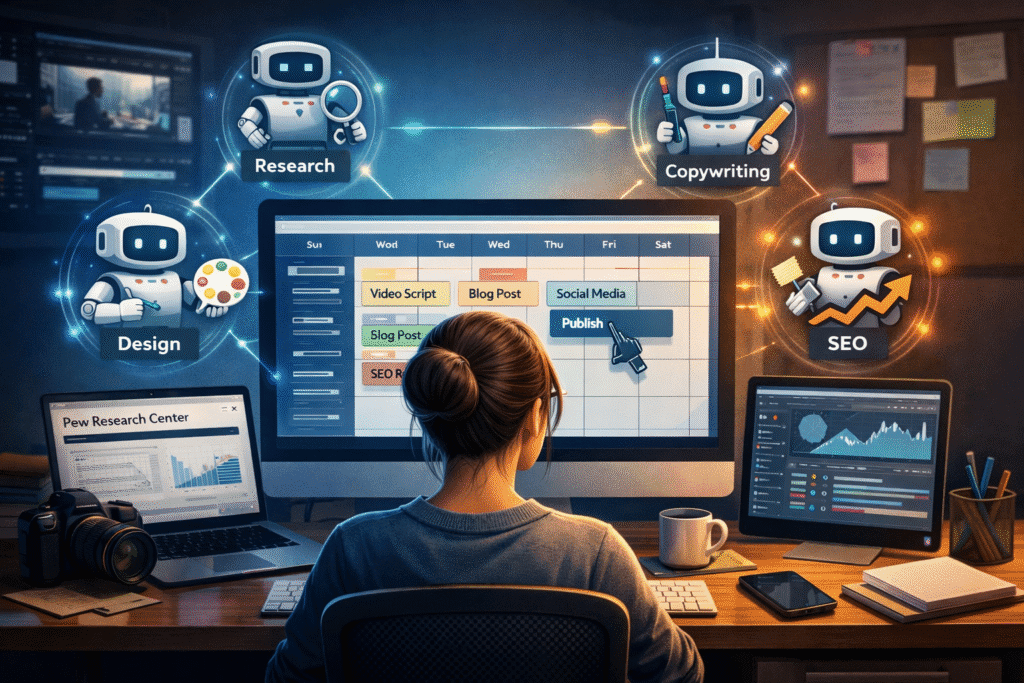
A simple agentic system might include:
A research agent monitoring trends and audience questions
A writing agent preparing first drafts
A distribution agent repurposing content
A performance agent tracking results
These ideas originate from AI Robotics & Agents, where autonomous systems coordinate tasks without constant human input.
Your role remains clear: direction, judgment, and approval.
The Creator’s New Role: From Worker to Director
With this level of automation, a common fear appears.
“Am I still needed?”
The answer is yes—more than ever.
In 2026, the internet is flooded with AI-generated content. Therefore, human judgment becomes the real differentiator. Taste, ethics, and emotional intelligence cannot be automated.
Successful Agentic AI for Creators workflows follow one rule: AI executes, humans decide.
You provide meaning.
The system provides scale.
Agentic AI Content Creation and the Future of SEO (GEO)
Search behavior has changed dramatically.
We are no longer optimizing only for traditional search engines. We are optimizing for generative engines.
This shift is known as GEO—Generative Engine Optimization.
When users ask AI assistants questions, those systems look for trusted, well-structured sources. If your content is clear and authoritative, agentic systems can select you as the primary reference.
Google itself highlights how AI-driven discovery is reshaping information access:
https://ai.googleblog.com
In this environment, clarity and structure matter more than volume.
Ethics, Trust, and Long-Term Authority
With powerful automation comes responsibility.
Agentic AI content creation introduces risks, including misinformation and over-automation. As a creator, you remain the gatekeeper of truth for your audience.
Linking to trusted sources, such as MIT Technology Review, helps reinforce credibility:
https://www.technologyreview.com
In a world where AI can scale manipulation, creators who scale trust will win.
How to Start Using Agentic AI Content Creation Today
You do not need a perfect system to begin.
Start small:
Automate one repetitive task
Keep human approval in place
Measure outcomes
Expand gradually
The most valuable skill in this new era is not prompting. It is goal-setting and system thinking.
Frequently Asked Questions
What is agentic AI content creation?
Agentic AI content creation refers to autonomous systems that plan, execute, and optimize content workflows toward long-term goals while humans maintain oversight.
Does agentic AI replace creators?
No. It replaces repetitive work, not creativity, judgment, or human taste.
Is agentic AI suitable for solo creators?
Yes. Solo creators benefit the most because systems multiply individual capacity.
Is agentic AI expensive?
Many tools offer flexible pricing, and the time saved usually outweighs the cost.
Conclusion: The Era of the Super-Creator
Agentic AI for Creators is not a trend. It is the new baseline.
Creators who build systems, stay human in control, and protect trust will lead the next decade of digital media. Those who rely only on effort will struggle—not because they lack talent, but because they lack leverage.
The future of content creation belongs to creators who direct intelligence, not those who merely generate output.

Fatima is the founder of SmartCreatorAI25, a blog that helps creators and bloggers use AI tools to grow smarter online. She shares practical guides about AI writing, monetization, and smart productivity.