
Many small bloggers struggle with traffic because they lack a clear AI SEO content system. They publish consistently, use AI tools daily, and still see almost no growth. I know this feeling because I experienced it myself.
At first, I believed more content would solve everything. However, traffic stayed flat. Eventually, I realized the issue wasn’t effort. It was structure.
This framework is not about producing more posts. Instead, it focuses on organizing content strategically so every article strengthens the next one.
Table of Contents
ToggleWhat Is an AI SEO Content System?
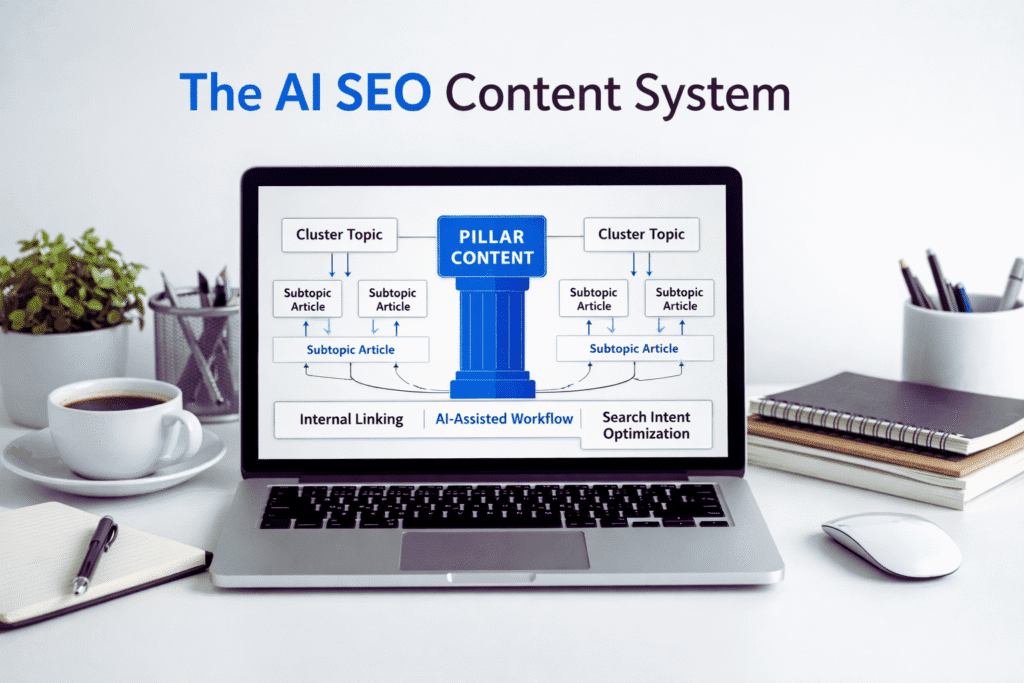
An AI SEO content system is a structured framework that organizes blog content into one main pillar page supported by multiple cluster articles. Rather than publishing random posts, it builds topical authority through internal linking and search intent alignment.
How the System Works:
Choose one focused pillar topic
Create 3–5 supporting cluster articles
Link clusters back to the pillar
Connect related clusters together
Optimize titles and meta descriptions for higher CTR
This structured approach builds authority gradually and keeps your blog organized.
Why the AI SEO Content System Prioritizes Structure
In 2026, search engines rank topical depth instead of isolated pages. Therefore, scattered posts weaken authority. On the other hand, connected content strengthens it.
Most small blogs fail because:
Topics are unrelated
Search intent is unclear
Articles are not linked properly
Competitive keywords are targeted too early
When structure is missing, Google struggles to understand expertise. Conversely, a clear content framework signals authority immediately.
As explained by Google Search Central, logical site structure improves crawlability and long-term SEO performance.
Structure builds clarity.
Clarity builds trust.
Trust builds rankings.
The 5 Phases of the AI SEO Content System
Phase 1 – Define Your Authority Pillar
Every structured blog begins with one central topic. Think of it as your “City Center.”
For example:
Pillar → AI SEO Content System
Cluster → AI SEO Workflow for Beginners
Cluster → AI Keyword Research for Small Blogs
Cluster → AI Internal Linking Strategy
Each cluster reinforces the pillar. Consequently, search engines understand hierarchy more clearly.
Without a defined center, content feels random. With one, growth becomes intentional.
Phase 2 – Map Search Intent Before Creating Content
Before generating content, analyze user intent carefully.
Ask yourself:
Is the reader looking to learn?
Compare tools?
Solve a specific issue?
Matching intent reduces cannibalization. Additionally, it increases ranking stability.
When I ignored intent early on, some of my posts competed against each other. After aligning content correctly, impressions stabilized within weeks.
Precision changes results.
Phase 3 – Apply a Repeatable SEO Workflow
Execution should always follow a system.
Here’s the simplified process:
Identify a low-competition angle
Build a structured outline
Generate content section by section
Add one personal insight
For detailed execution, read AI SEO Workflow for Beginners.
I call this the “Cyborg Method.”
AI builds structure.
You provide experience.
Once I stopped chasing volume and followed this method, traffic stopped feeling random and started feeling predictable.
Consistency compounds.
Phase 4 – Internal Linking Architecture
Internal linking is the backbone of this structured content framework.
Use this model:
Link UP → every cluster links to the pillar
Link ACROSS → clusters connect to related clusters
Link DOWN → pillar links back to clusters
To understand this fully, review AI Internal Linking Strategy.
After implementing this structure, older posts began gaining impressions without additional backlinks.
That’s the power of connection.
Phase 5 – Optimize Click-Through Rate
Ranking alone is not enough. You also need clicks.
Improve CTR by:
Using numbers in titles
Highlighting clear benefits
Matching snippet expectations
Writing persuasive meta descriptions
If you feel stuck despite working hard, chances are you don’t need more content — you need better structure.
Small refinements produce measurable growth.
AI SEO Content System vs Random Publishing
| Random Publishing | Structured Content Framework |
|---|---|
| Unrelated topics | Organized pillar + clusters |
| No internal linking | Intentional linking network |
| Broad keyword targeting | Focused long-tail strategy |
| Slow authority growth | Compounding topical authority |
The difference is architectural.
How Long Does the AI SEO Content System Take to Show Results?
Most small blogs begin noticing authority signals within 3–6 months when applying this system consistently.
Expected Timeline:
Month 1 → Structure setup
Month 2–3 → Cluster expansion
Month 4–6 → Authority compounding
Although patience is required, improvements in crawl activity often appear within 30–60 days.
Common AI SEO Content System Mistakes
Even structured blogs can struggle when rushed.
Avoid:
Publishing without hierarchy
Linking only to the homepage
Overusing identical anchor text
Ignoring old content updates
Chasing highly competitive keywords too early
Focus beats force every time.
AI SEO Content System – Quick Recap
Define your pillar
Build supporting clusters
Link intentionally
Match search intent
Optimize CTR
No chaos.
No random publishing.
Just structure.
Frequently Asked Questions
What is an AI SEO content system?
An AI SEO content system is a structured framework that organizes blog posts into pillars and clusters to build authority and improve rankings.
How long does it take to see results?
Most small blogs see authority signals within 3–6 months when publishing consistently and linking strategically.
Is internal linking necessary?
Yes. Internal linking helps search engines understand content relationships and distribute authority effectively.
Can small blogs compete with larger websites?
Absolutely. By focusing on structured clusters and long-tail keywords, small blogs can build authority steadily over time.
Final Thoughts
The AI SEO content system for small bloggers is not about working harder.
It’s about working strategically.
When you stop publishing randomly and start building with structure, growth becomes predictable.
Authority compounds.
One intentional step at a time.

Fatima is the founder of SmartCreatorAI25, a blog that helps creators and bloggers use AI tools to grow smarter online. She shares practical guides about AI writing, monetization, and smart productivity.