
Table of Contents
ToggleKey Takeaways (2026 Update)
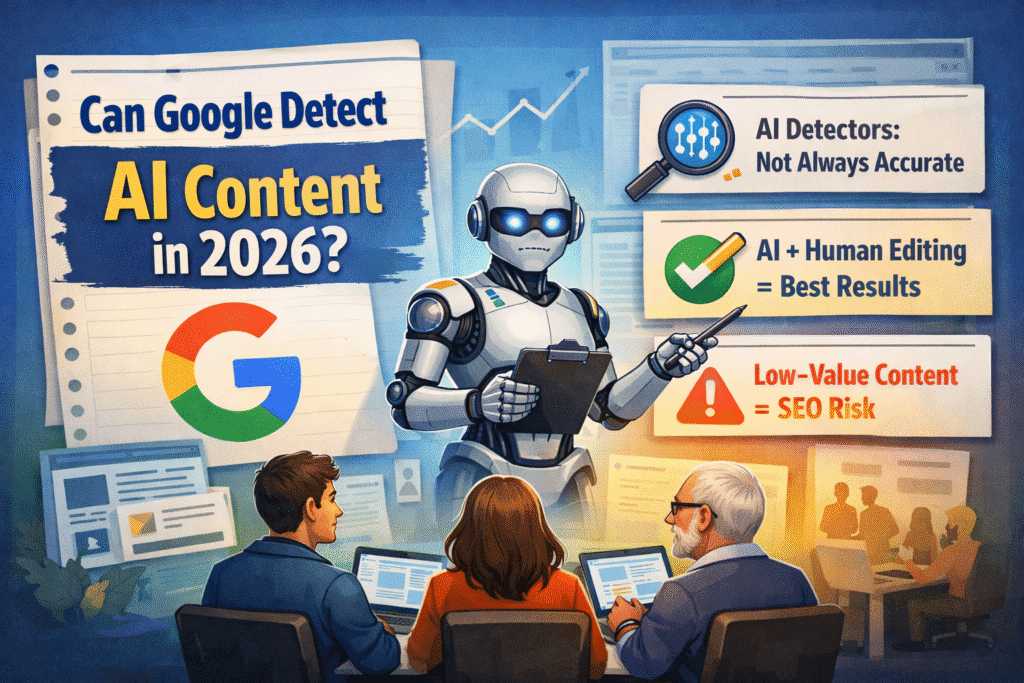
Google AI content detection does not work like AI detector tools.
Google evaluates usefulness and outcomes, not writing methods.
AI detectors are not used in Google’s ranking systems.
Low-value and repetitive content is the real SEO risk.
The best results come from AI assistance combined with human editing and experience.
In 2026, Google AI content detection has become a major concern for creators as artificial intelligence tools are now widely used in writing and publishing.
AI-assisted content appears everywhere—from blog posts and emails to product pages and research drafts.
This leads to one critical question many creators ask:
Can Google actually detect AI-written content in 2026?
Some fear penalties.
Others believe Google doesn’t care at all.
The truth is more nuanced.
In this guide, we explain what Google evaluates, what it ignores, and how creators can safely use AI without risking rankings, trust, or visibility.
The Growing Need for AI Detection in 2026
Artificial intelligence has reshaped digital content creation.
Today, AI is embedded in blogging, marketing, education, and research.
However, the real issue in 2026 is not which tools exist—but whether AI detection itself is reliable.
AI detector tools are often used to support academic integrity and publishing transparency. According to Forbes, AI writing has become widespread online, with research showing significant adoption across digital publishing.
This rapid growth has increased the demand for trust, clarity, and quality control in content creation.
How AI Detector Tools Work
Most AI detector tools rely on statistical and linguistic analysis, not factual verification.
They typically analyze:
Perplexity (predictability of word patterns)
Burstiness (variation in sentence structure)
Stylistic signals (tone and phrasing)
Token probability (likelihood-based generation)
The result is a probability score, not proof of authorship.
This distinction is essential when interpreting detection results.
Are AI Detectors Actually Reliable in 2026?
AI detectors rely on probability rather than certainty.
As a result:
False positives are common, especially with formal writing
Hybrid human + AI content is difficult to classify
Accuracy varies by language and topic
In short, AI detection provides guidance, not certainty.
This explains why content can be flagged as AI-written by a detector and still perform well in search results.
AI Detector 2026: Are AI Detection Tools Still Accurate?
How We Tested AI Content Performance in 2026 (Experience)
In early 2026, we tested multiple publishing workflows:
AI drafts published without editing
AI-assisted drafts edited and restructured by humans
Fully human-written articles
Across all tests, one pattern was consistent.
Content that combined AI drafting with human editing, clearer intent, and added experience performed better in rankings and engagement.
None of the AI-assisted articles were penalized because AI was involved.
Performance depended on usefulness, clarity, and originality.
This confirms a core reality of modern search:
Google evaluates outcomes—not tools.
Why AI Detectors Are Not Google’s System
Many creators confuse AI detectors with Google’s ranking systems.
They are fundamentally different.
AI detectors attempt to guess authorship using linguistic probability.
Google evaluates:
usefulness
engagement
satisfaction signals
comparison with competing results
Much of the confusion around Google AI content detection comes from mixing these two systems.
Understanding search intent and content structure remains one of the strongest SEO signals today.
SEO for Content Creators: Keyword Research Tips for Beginners
SEO experts at Search Engine Journal also emphasize that AI detection tools should never be used alone, but combined with human editorial judgment.
Can Google Penalize AI Content?
Google does not penalize content simply because AI was used.
Penalties occur when content:
is spammy
is mass-produced without value
manipulates rankings
offers no original insight
Google has clearly stated that AI-generated content is acceptable as long as it is created for people and provides value, according to Google Search Central.
Concerns about Google AI content detection usually come from confusing spam policies with AI-assisted writing.
Can Google Tell the Difference Between Human and AI Content?
Not reliably.
AI Content Can Look Human
Once edited and refined, AI-assisted writing often becomes indistinguishable from human writing.
Human Content Can Look AI-Like
Formal or technical writing can trigger detectors, but Google does not rely on style alone.
Style Is Not a Ranking Factor
Google ranks content based on value, not how “human” it sounds.
Visual Insight: From AI Draft to Google Rankings
Recommended infographic (2026):
From AI Draft to Google Rankings
Raw AI draft
Human editing and restructuring
Search intent alignment
Experience added
Final publish
Google visibility
This reflects how high-performing content is created today.
How Creators Should Use AI Safely in 2026
Use AI as an Assistant
AI is effective for brainstorming, outlining, summarizing, and drafting.
Many creators rely on AI writing tools to speed up these steps, but real value comes from refinement.
AI Writing Tools: How to Write Blog Posts Faster and Smarter (internal link)
Edit With Intent
Human editing adds clarity, structure, and direct answers.
Add Experience and Perspective
Even small insights signal trust and expertise.
Write for Humans First
If users find your content helpful, Google usually agrees.
Fear-based optimization causes more harm than AI itself.
The Real Risk Isn’t AI — It’s Low-Value Content
In 2026, the biggest ranking risks remain:
thin articles
recycled ideas
surface-level explanations
AI simply accelerates bad content.
Creators who understand Google AI content detection focus on quality instead of fear.
Frequently Asked Questions (FAQ)
Can Google detect AI-written content in 2026?
Google does not directly detect AI-written content. It evaluates quality, usefulness, originality, and user satisfaction.
Does Google penalize AI-generated content?
No. Google penalizes spam and low-value content—not AI assistance.
Is AI content bad for SEO?
AI content is safe for SEO when edited, useful, and aligned with search intent.
How can creators use AI without risking rankings?
Use AI for support, edit carefully, add insight, and prioritize users.
Conclusion: What Really Matters in 2026
Google doesn’t judge how content is written.
It judges what the content delivers.
AI is a tool.
Quality is the standard.
Creators who focus on clarity, usefulness, and trust don’t need to fear AI—or Google.

Fatima is the founder of SmartCreatorAI25, a blog that helps creators and bloggers use AI tools to grow smarter online. She shares practical guides about AI writing, monetization, and smart productivity.