
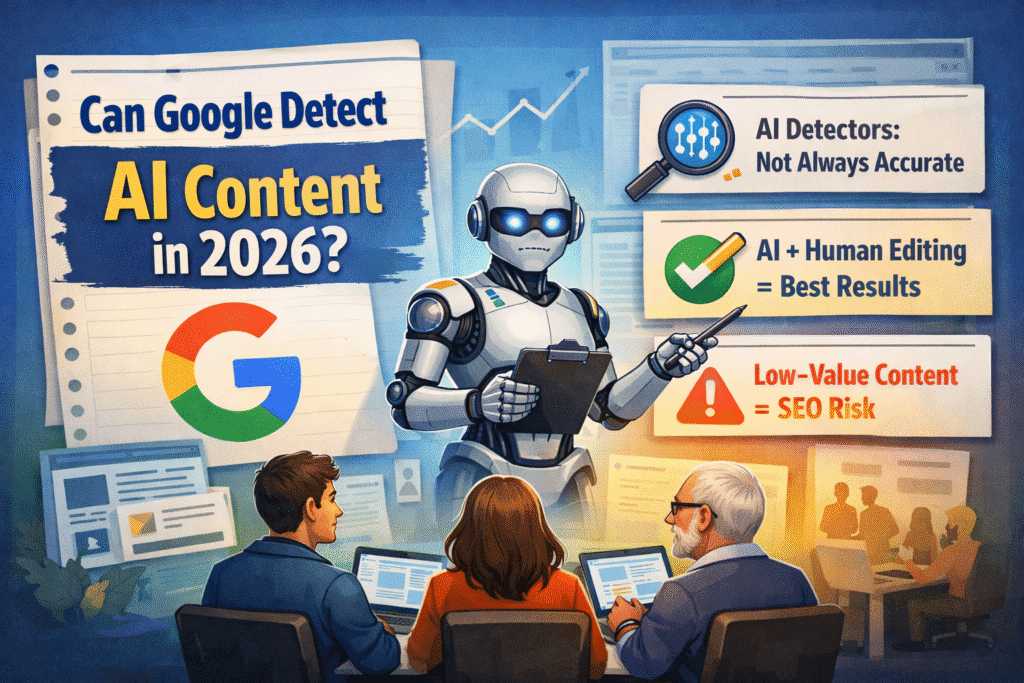
AI tools are now part of everyday content creation. Bloggers, marketers, and businesses use them to generate ideas, draft articles, and speed up their workflow.
Because of that, one question appears again and again:
Can Google detect AI-written content?
Some creators believe AI content is automatically penalized. Others think Google cannot detect it at all.
The truth is somewhere in the middle.
Google is not trying to identify whether a human or an AI wrote a piece of content. Instead, the search engine focuses on something much simpler.
Is the content actually helpful?
If a page provides clear, useful information that satisfies the user’s search intent, it can rank well—regardless of how it was written.
Understanding this principle helps creators use AI confidently without fearing penalties.
Table of Contents
ToggleWhat Is Google AI Content Detection?
When people talk about Google AI content detection, they usually mean the ability of search engines to recognize AI-generated writing.
However, Google’s systems do not work the same way as typical AI detector tools.
Most AI detectors analyze writing patterns. They measure things like sentence predictability, stylistic variation, and word probability. Based on these signals, they estimate whether a text might be generated by AI.
Google works differently.
Instead of trying to identify authorship, the algorithm evaluates the value of the content itself.
It looks at signals such as:
usefulness of the information
relevance to the search query
clarity of explanations
user engagement signals
In other words, Google focuses on whether the content helps readers solve their problems.
According to Google’s helpful content guidelines, websites should prioritize people-first content that delivers genuine value.
Why AI Detection Tools Became Popular
As AI writing tools became widely accessible, many organizations started looking for ways to identify AI-generated content.
Universities, publishers, and research institutions began using AI detection tools to estimate whether text was written by humans or machines.
Most AI detectors rely on statistical analysis.
They usually evaluate:
perplexity (predictability of text patterns)
burstiness (variation in sentence structure)
stylistic signals
token probability models
However, these systems produce probability scores rather than definitive answers.
That means detection tools can make mistakes.
Human writing can sometimes look like AI output, while heavily edited AI drafts can appear completely human.
Are AI Detectors Reliable in 2026?
Despite improvements, AI detectors are still far from perfect.
Several limitations affect their reliability.
First, many tools generate false positives. Structured or academic writing may be flagged as AI-generated even when written entirely by humans.
Second, hybrid content is difficult to classify. Today, many creators combine AI drafts with human editing. As a result, detection tools struggle to determine authorship.
Third, accuracy varies depending on language and topic.
Because of these limitations, content flagged as AI-written can still perform well in search rankings.
Google Search Evaluation vs AI Detector Tools
Many creators confuse AI detection tools with Google’s ranking systems.
However, these systems operate very differently.
| Google Search Evaluation | AI Detector Tools |
|---|---|
| Evaluates usefulness and relevance | Estimates probability of AI writing |
| Focuses on user experience | Focuses on linguistic patterns |
| Uses ranking algorithms | Uses statistical analysis |
| Measures content value | Measures writing style |
This comparison highlights an important point.
Google does not try to determine authorship. Instead, it evaluates how valuable the content is for readers.
Can Google Penalize AI Content?
Google does not penalize content simply because AI tools were used.
However, penalties can occur when content:
is spammy
is mass-produced without value
manipulates search rankings
lacks original insights
In other words, the real problem is low-quality content, not AI assistance.
Creators who focus on providing useful information rarely face penalties.
Can Google Distinguish Between AI and Human Writing?
In many cases, the difference is difficult to detect.
AI Content Can Appear Human
When AI drafts are carefully edited and refined, the final article often becomes indistinguishable from human writing.
Human Writing Can Appear AI-Generated
Formal or structured writing sometimes triggers AI detectors even when written entirely by humans.
Style Alone Is Not a Ranking Factor
Google ranks content based on usefulness, not whether it sounds human.
5 Ways to Use AI Safely for SEO
Creators can use AI safely by following a structured workflow.
Use AI for brainstorming and research
Generate outlines before writing
Edit AI drafts manually
Add personal insights and examples
Align the content with search intent
When these steps are followed, AI becomes a powerful assistant rather than a risky shortcut.
If you want to improve your AI writing workflow, you can explore AI Writing Tools: How to Write Blog Posts Faster and Smarter.
The Real Risk: Low-Value Content
In 2026, the biggest SEO risk is not AI usage.
The real problem is low-value content.
Examples include:
thin articles
recycled ideas
shallow explanations
content created only to manipulate rankings
AI tools simply make it easier to produce this type of content quickly.
Creators who understand Google AI content detection focus on improving content quality instead of fearing automation.
If your website struggles to gain traffic, you may want to read Why Your Blog Gets No Traffic in 2026, which explains common visibility problems.
Frequently Asked Questions
Can Google detect AI-written content?
Google does not directly detect AI-generated writing. Instead, it evaluates usefulness, originality, and user satisfaction signals.
Does Google penalize AI-generated content?
No. Google penalizes spam and low-value content, not AI assistance.
Is AI content bad for SEO?
AI content can rank well when it is edited carefully, provides value, and aligns with search intent.
How should creators use AI safely?
Creators should use AI for drafting and research while adding human insights, clear explanations, and proper structure.
Conclusion
Google does not judge how content is written.
It judges what the content delivers.
Artificial intelligence is simply a tool.
Creators who focus on clarity, usefulness, and trust will continue to succeed—whether AI is involved or not.
Quality remains the real ranking factor.

Fatima is the founder of SmartCreatorAI25, a blog that helps creators and bloggers use AI tools to grow smarter online. She shares practical guides about AI writing, monetization, and smart productivity.