
Agentic AI for creators is transforming how digital content is planned, executed, and scaled.
Instead of relying on endless manual effort, creators are now building autonomous systems that work toward clear goals while humans remain firmly in control.
For years, creators were told that success meant producing more content.
Post more. Publish faster. Be everywhere.
However, something fundamentally different is happening today.
We are no longer just generating content.
Instead, we are entering the era of executing intelligent systems.
This article explains that shift from a creator’s perspective — clearly, practically, and without hype.
What Is Agentic AI? (Explained for Creators)
Most creators already use AI in a reactive way.
You write a prompt.
The AI responds.
That model is called generative AI.
Agentic AI works differently.
Rather than waiting for instructions, an agentic system acts toward a defined goal.
For example, instead of asking:
“Write a blog post about AI tools,”
An agentic system operates like this:
“Traffic declined on two pages. I analyzed search intent, refreshed internal links, updated outdated sections, and prepared a revised draft for review.”
The difference here is agency.
Agentic AI systems can:
Break complex goals into logical steps
Decide which tools to use
Execute multi-step workflows
Learn from results over time
This learning behavior closely relates to self-evolving AI systems, where intelligence improves through feedback rather than fixed rules.
Generative AI vs Agentic AI: The Structural Difference
To understand why this shift matters, the distinction must be clear.
| Feature | Generative AI | Agentic AI |
|---|---|---|
| Core behavior | Responds to prompts | Works toward goals |
| Control model | Human-driven | System-driven |
| Task handling | Single task | Multi-step execution |
| Memory | Short-term context | Long-term learning |
| Tool usage | Limited | Uses browsers, CMS, APIs |
| Creator role | Operator | Director |
| Scalability | Linear | Exponential |
Generative AI helps you produce.
Agentic AI helps you operate.
As a result, the creator’s role fundamentally changes.
From Creation to Direction: The Mindset Shift
Most creators are trapped in a production loop:
Research → Write → Edit → Publish → Promote
This loop leads to burnout because progress depends entirely on energy.
Agentic AI breaks that cycle.
Instead of asking:
“What should I create next?”
The system proposes:
“Here are three opportunities based on audience behavior and search demand.”
This progression often begins when creators experiment with isolated tools, such as those covered in AI tools for bloggers, before connecting them into structured systems.
Agentic AI is simply the next logical step.
How Content Creation Changes with Agentic AI
The impact becomes clear when workflows are compared side by side.
| Aspect | Traditional Creation | Agentic AI Creation |
|---|---|---|
| Research | Manual | Continuous monitoring |
| Writing | Human-only | AI + human review |
| Editing | Manual | Iterative system updates |
| Publishing | Single platform | Multi-platform orchestration |
| Consistency | Energy-dependent | 24/7 execution |
| Burnout risk | High | Low |
| Scaling | Requires hiring | Requires agents |
In practice, creators who scale do not work harder.
They design better systems.
Building an AI Content Team (The Swarm Model)
Agentic AI works best as a team of specialized agents, not a single assistant.
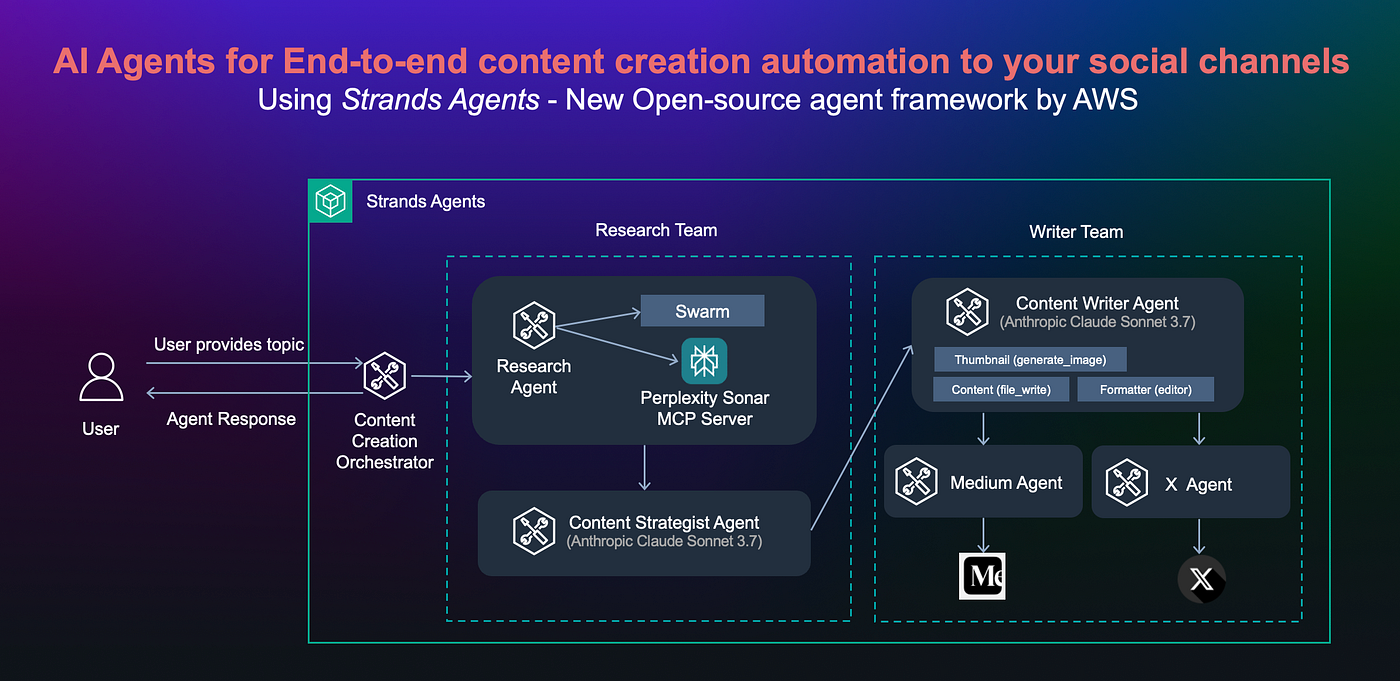
| AI Agent | Responsibility | Human Role |
|---|---|---|
| Research Agent | Trend & demand monitoring | Approves ideas |
| Strategy Agent | Topic prioritization | Sets direction |
| Writing Agent | Draft creation | Reviews voice |
| Distribution Agent | Repurposing & scheduling | Final approval |
| Performance Agent | SEO & engagement tracking | Adjusts strategy |
| Community Agent | Comment moderation | Handles key interactions |
This structure allows a solo creator to operate like a media company — without hiring or burnout.
Agentic AI and SEO: From Static to Living Systems
Traditional SEO is reactive.
You optimize, publish, and wait.
Agentic SEO is adaptive.
Systems can:
Monitor SERP changes
Detect declining pages
Refresh content automatically
Improve internal linking continuously
This aligns with advanced SEO systems for creators, where SEO becomes an ongoing infrastructure rather than a checklist.
Planning and Execution at Scale
Agentic workflows rely on orchestration, not improvisation.
Structured planning systems allow agents to coordinate research, writing, and publishing seamlessly.
This is best understood through AI-driven content strategy systems, which transform planning into repeatable processes.
As a result, scale increases without chaos.
The Human-in-the-Loop Principle
One rule matters above all:
AI executes. Humans decide.
Without human oversight, systems drift.
Creators remain responsible for:
Editorial judgment
Emotional resonance
Ethical boundaries
Brand alignment
Agentic AI handles workload.
Humans protect meaning.
Industry Validation: This Shift Is Real
This transition is not speculative.
According to McKinsey’s analysis of AI agents, autonomous systems are restructuring knowledge work across industries — not by replacing humans, but by changing how work is organized.
Creators are simply among the first to feel this shift.
Why Agentic AI Reduces Burnout
Burnout happens when output depends on willpower.
Agentic systems remove that dependency by:
Automating repetitive tasks
Maintaining consistency
Preserving creative energy
This mirrors principles seen in AI-powered productivity workflows, where sustainability replaces hustle.
Ethics, Trust, and the Creator Economy
As AI content becomes harder to detect, trust becomes the real currency.
Creators who:
Are transparent about AI use
Respect audience intelligence
Avoid manipulation
Will build stronger communities.
Agentic AI can scale deception.
It can also scale honesty.
The choice is strategic.
Conclusion: Lead or Follow
Agentic AI for creators is no longer optional.
It is the new baseline.
Creators who:
Build systems
Keep humans in control
Protect trust and taste
Will lead the next decade of digital media.
Those who rely only on effort will struggle — not because they lack talent, but because they lack leverage.
Frequently Asked Questions
What is Agentic AI for creators?
Agentic AI for creators refers to autonomous AI systems that plan, execute, and optimize content workflows toward long-term goals while humans maintain oversight.
Does Agentic AI replace human creators?
No. It replaces repetitive labor, not creativity, judgment, or taste.
Is Agentic AI expensive?
While advanced systems may involve higher costs, the time saved and scalability usually outweigh the investment.
Do creators need coding skills?
No. Many modern platforms offer no-code and low-code agentic workflows.

Fatima is the founder of SmartCreatorAI25, a blog that helps creators and bloggers use AI tools to grow smarter online. She shares practical guides about AI writing, monetization, and smart productivity.